Key Takeaways
- Public NTP pool servers are unsuitable for enterprise use: They offer no SLA, no accountability, and highly variable accuracy due to volunteer infrastructure, circular peering, and DNS caching issues.
- Accuracy and reliability are critical for security and compliance: Even small time drift can break authentication, logging, audits, and transactions—risks that public pools cannot reliably mitigate.
- Testing shows a clear performance gap: Dedicated internal Stratum 1 NTP servers stay within sub-millisecond accuracy, while even the best pool servers regularly drift by tens to hundreds of milliseconds.
- Internal GPS-synchronised NTP servers eliminate risk and dependency: Galleon Systems Stratum 1 NTP servers deliver sub-millisecond accuracy, full control, and enterprise-grade reliability for business-critical time synchronisation.
Article Contents:
- What is an NTP Pool?
- How Does the NTP Pool Work?
- What are the Security Considerations for the NTP Pool?
- Why Use an Internal NTP Time Server?
- Testing an Internal NTP Server vs Pool Servers
- Case Study: Individual Contributor Issues
- Three Core NTP Pool Problems
- How Much Can Unsynchronised Time Cost Your Business?
- Reliable Time for Your Network with Galleon NTP Servers
- Conclusion: Why Internal Servers Are Required
- Best Time Server Options for UK Businesses?
What is an NTP Pool?
The NTP pool is a community project providing free access to network time servers run by thousands of volunteers worldwide. For hobbyists, small labs, and home networks, it’s an easy, low cost way to keep clocks “reasonably accurate.” In an NTP server vs pool server comparison, the NTP pool refers to a collection of NTP time sources that work together to provide an averaged network time reference.
However, while the NTP pool is legitimate in purpose, it operates as a best effort service only. It makes no guarantees of uptime or precision, and server performance varies. That’s fine for home projects, but not for organisations where time accuracy underpins security, compliance, and operations. For large businesses, the NTP server vs pool servers comparison comes down to control, accountability, and reliability. A drift of even a few seconds can break authentication systems, corrupt data, or cause regulatory failures. The NTP pool has no service guarantees, and there’s no customer support when issues arise, which is why enterprises use dedicated, GPS synchronised NTP servers instead.
For an explanation of “What is NTP,” take a look at our Beginner’s Guide, where we walk through it step by step.
How Does the NTP Pool Work?
The NTP pool works on volunteer infrastructure. The NTP pool can consist of an unknown number of time sources, ranging from PC software and Raspberry Pi’s to outdated unsupported time servers. Furthermore, there’s no clear disclosure of what these devices are, how many exist, or whether they provide accurate time to begin with. There’s no SLA (Service Level Agreement), uptime commitment, or support if a server fails. Contributors can disconnect at any time, and overloaded or misconfigured servers may deliver poor results.
For enterprises that depend on consistent, verifiable time, this lack of control is a major risk. Internal NTP servers, synchronised to trusted sources, remove that uncertainty.
What are the Security Considerations for the NTP Pool?
Accuracy Varies
Not all pool servers are equal. Some connect directly to GPS or atomic clocks, others rely on other internet servers, introducing delay and drift.
For casual use, that’s acceptable. But for systems handling financial transactions, distributed data, or security protocols, even small inaccuracies can cause serious problems. Dedicated NTP servers provide the precision and consistency that public pools can’t guarantee.
Risk of Blocking or Rate Limiting
When thousands of devices in one network query the public NTP pool directly, traffic can be mistaken for abuse. The project specifically warns against this. If blocked or rate limited, time synchronisation across your business could fail instantly.
External Dependency
The NTP pool exists outside your control. If a volunteer operator shuts down a server or their ISP experiences issues, your systems suffer. Depending on unpaid external resources for critical infrastructure introduces unnecessary points of failure.
Compliance and Accountability
Many industries must prove accurate, traceable time for auditing and legal purposes. “We used the NTP pool” won’t satisfy regulators. Internal NTP servers, however, provide clear logs showing where time comes from, how it’s distributed, and how it’s monitored, ensuring compliance and accountability.
Why Use an Internal NTP Time Server?
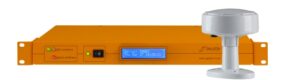
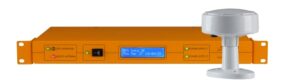
Dedicated NTP servers give businesses reliability, stability, and control. Internal servers, synced to GPS or regional time authorities, can distribute accurate time to all systems, eliminating dependence on the public pool.
They’re simple to run, inexpensive to maintain, and become a permanent, secure layer of your infrastructure, much like DNS or DHCP.
A reliable NTP time server provider should offer Stratum 1 devices with a dedicated time source to deliver high-precision synchronisation across critical networks. Robust systems are typically capable of handling hundreds of thousands of NTP requests per minute, ensuring consistent and accurate time distribution.
For even greater accuracy, leading providers support external GPS antennas featuring multi-channel timing receivers compatible with multi-GNSS satellite systems, including GPS, SBAS, and QZSS. In addition, configurations using dual-power time servers or multiple servers that peer with one another help maintain network reliability and provide redundancy if power or individual units become unavailable.
Finally, dependable manufacturers back their systems with long warranties, lifetime technical support, and rapid service options to minimise downtime at critical moments.
Testing an Internal NTP Server vs Pool Servers
Galleon Systems conducted a 24 hour evaluation of the NTP Pool using a controlled and repeatable test environment. We used a dedicated NTP enterprise time server equipped with a 10 gigabit internet connection and synchronised it to a GPS antenna. Throughout the entire test period, the server maintained a time accuracy of within 0.01 milliseconds of the GPS reference.
To ensure fairness and avoid bias, the server was configured with 50 IPv4 addresses and 50 IPv6 addresses. DNS caching was disabled for every address so that each query to the NTP Pool reflected a fresh lookup rather than previously cached results.
Every 64 seconds, each IP address independently requested a list of recommended UK NTP Pool servers. Once the pool returned its recommended servers, we queried those servers and recorded their responses, later graphing the results against our dedicated internal server over the pool.
Using multiple IP addresses increased the diversity of server selections received from the pool, giving us a broader and more representative dataset while still keeping load on the pool to a minimum. Each IP only performed one query every 64 seconds, ensuring that our testing did not place excessive strain on the NTP Pool infrastructure.
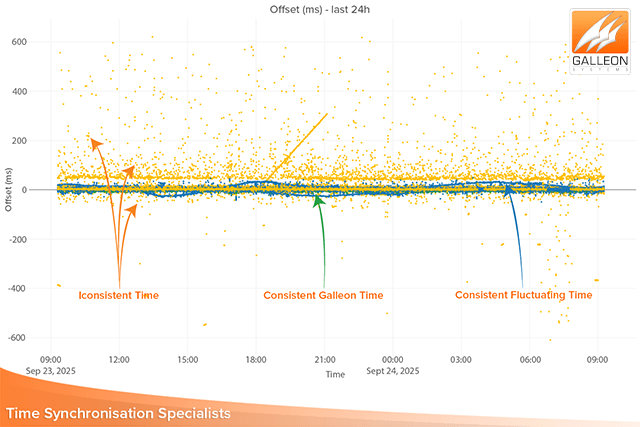
This test highlighted that the most reliable devices in the NTP Pool, across the UK, operated consistently within up to 50 ms of true time. However, when compared to an in-house time server, which typically operates within <1 ms of true time, the significant gap in accuracy and time drift becomes clear.
The image below shows how NTP Pool devices consistently drift away from the zero line, while a dedicated network time server synchronised to a trusted GPS time source operates reliably close to zero-line true time.
The yellow points represent NTP servers that are unable to provide consistent time. The blue points show servers that do deliver consistent time, but fluctuate constantly. The green points, though harder to see, represent Galleon Systems’ own NTP servers, which were tested over the public internet (via the NTP Pool) to ensure a fair comparison.
The Best of the Pool
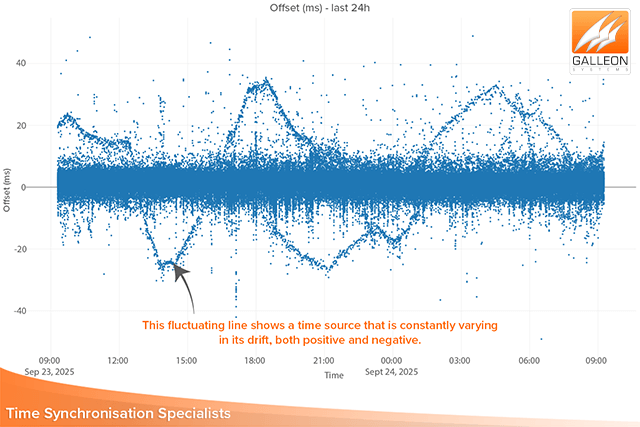
Some NTP pool servers perform well, staying within 50 ms of true time. However, “circular peering”, as shown below, where servers sync from one another, causes drift patterns and unstable clusters. While adequate for small setups, this inconsistency poses serious issues for distributed business systems.
The Worst of the Pool
As shown below, other pool servers deviate by hundreds of milliseconds. Such variance renders them unsuitable for enterprise environments, where inaccurate timestamps can break logging, security, and compliance functions.

Galleon System’s Contributions
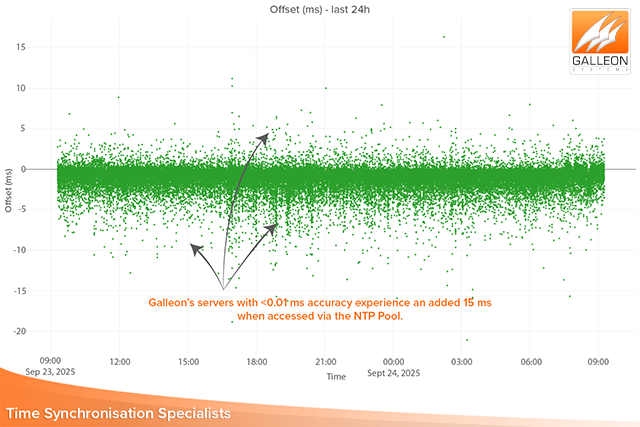
These are the NTP servers that Galleon Systems contributes via the NTP Pool. As shown, they achieve an over-the-internet accuracy of around added 15 milliseconds while operating under real-world load, via the NTP Pool.
Each server consistently provides about 10 Mb/s of NTP traffic, which corresponds to roughly 26,000 requests per second. Across all 50 servers, this results in approximately 1,300,000 requests per second and a steady combined bandwidth usage of around 500 Mb/s.
Against a dedicated in-house stratum 1 Galleon NTP time server, the accuracy improves to within 0.01 milliseconds. However, when filtered through the NTP Pool, up to additional 15 milliseconds can be introduced, showing how the Pool inherently distorts device time.
All Results Combined
Overlaying all results reveals a clear NTP server vs pool servers contrast: dedicated servers stay tightly aligned to true time, while public pool servers scatter widely. This inconsistency highlights why enterprises can’t rely on random volunteer servers for critical systems.
Case Study: Individual Contributor Issues
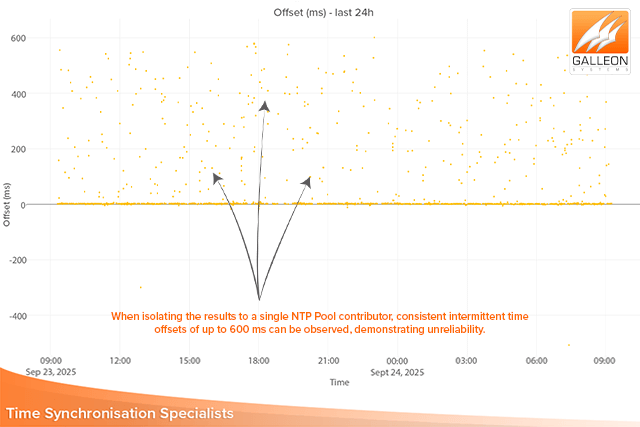
The graph below illustrates a single NTP pool contributor located in Braintree, UK. The server operates on a DSL internet connection with limited bandwidth. Under load, the server alternates between delivering accurate time and responses offset by as much as 600 ms. While this is not malicious, it reflects the uneven quality of volunteer infrastructure. For any enterprise relying on this server, the result would be unpredictable and unreliable system time.
Three Core NTP Pool Problems
Firstly, one of the biggest issues with the NTP Pool is DNS caching. The NTP Pool sets a DNS TTL of about two minutes so that devices will regularly ask for an updated list of time servers. However, many routers and DNS systems ignore this and cache the result for an hour or even longer. Because of this, even if the NTP Pool removes or disables a bad server, many devices will continue using it simply because their local DNS resolver will not request new information. This means the NTP Pool can react quickly, but many devices cannot.
Secondly, another major problem is circular peering. Some servers in the NTP Pool do not synchronise to a physical, accurate time source such as GPS. Instead, they synchronise to other servers in the same pool. This can create a loop where servers are syncing to each other rather than to a reliable reference. If one server begins drifting or becomes inaccurate, that error can spread through the loop, causing the entire group of servers to become inaccurate.
A third issue comes from the fact that most internet connections do not have equal send and receive speeds. NTP assumes that the time it takes to send a packet and receive a reply is the same. For example, if a packet takes 10 milliseconds round-trip, NTP assumes it took 5 milliseconds each way and adjusts the clock accordingly. But on real residential internet connections, upload and download speeds are often very different. In a simple example, the packet might take 4 milliseconds to send and 6 milliseconds to return, still totalling 10 milliseconds. NTP will assume 5 and 5, leading to a one-millisecond error. On slower or older connections like ADSL, this difference can be much greater, causing even larger time errors.
The NTP Pool also struggles in regions where there are not enough volunteer servers. When a country or area has very few contributors, the pool can run out of local bandwidth and available servers. As a result, requests from that region are routed to servers in other countries. A good example is China, which has almost no volunteers but is one of the largest users of the NTP Pool. Because of this, its traffic is spread across servers worldwide, and a significant amount of the NTP requests received on our own volunteer servers come from China. This massively distorts the round-trip time, often pushing it well over 100 milliseconds and making it highly non-symmetrical. As a result, the accuracy of the NTP Pool for devices in these regions can vary greatly.
How Much Can Unsynchronised Time Cost Your Business?
The cost of inaccurate time or a complete loss of time synchronisation creates a Single Point of Failure (SPOF) that can cause severe disruption for any business that depends on accurate timing. When synchronisation fails, networks can experience outages, service interruptions, and transaction errors that quickly erode service credibility with both current and future customers.
For example, Galleon supported an organisation who while using the NTP pool lost time synchronisation across its network. The system defaulted to an outdated Windows backup server from the 1990s, locking all global staff out of their systems because, technically, they did not yet exist within the network’s current time frame.
Every second of lost time translates into financial loss, locked out staff, failed transactions, and additional IT labour spent identifying, resolving, and implementing a fix. Every second counts.
Ultimately, the downtime cost of inaccurate time far exceeds the investment required to install a reliable NTP enterprise time server. Moreover, attempting to deploy a new NTP server solution after losing synchronisation, especially when relying on public NTP pools, only increases pressure and implementation complexity.
Reliable Time for Your Network with Galleon NTP Servers
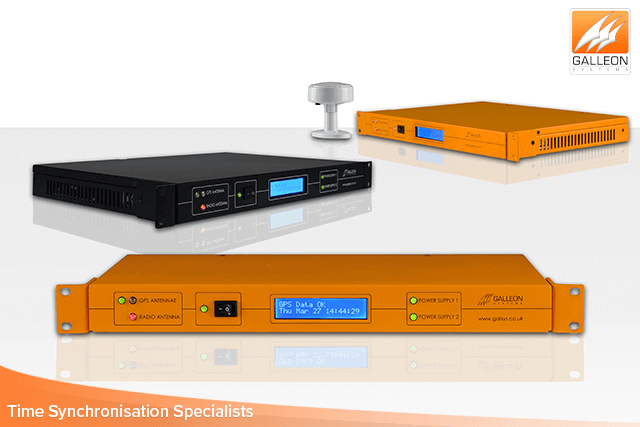
For organisations where accurate, consistent time is essential, relying solely on the public NTP pool carries unnecessary risk. Galleon Systems GPS synchronised NTP servers deliver precise, dependable time that your entire network can trust. Using dedicated internal servers reduces variability, removes external dependencies, and ensures systems meet compliance and security requirements.
By integrating Galleon NTP servers, businesses can build a solid foundation for accurate, risk-free time, supporting authentication, logging, and distributed systems. This sets the stage for adopting internal servers as a core part of a secure and reliable infrastructure. Explore our GPS NTP Servers here.
Conclusion: Why Internal Servers Are Required
The NTP server vs pool comparison shows clear results… The NTP pool is ideal for learning and small networks, but its variability, circular peering, and lack of guarantees make it unreliable for business use.
Enterprises should run at least two internal NTP servers synchronised to trusted GPS or national time sources. This ensures precise, consistent time, supports compliance, and eliminates dependence on volunteer infrastructure.
In modern enterprise networks, accurate time isn’t optional – it’s a core part of secure, reliable infrastructure.
Best Time Server Options for UK Businesses?
Galleon Systems has over 30 years’ experience manufacturing time servers, clocks and software for customers like Vodafone, Ford and HSBC.
Get in touch for a no-obligation chat about the NTP pool vs NTP server
Fill in a contact form or call 0121 608 7230 for help choosing the right time server for you.
Contact Us Now