Archive for the ‘gps time server’ Category

The Greenwich Time Lady

Wednesday, October 26th, 2011

Time synchronisation is something easily taken for granted in this day and age. With GPS NTP servers, satellites beam down time to technologies, which keeps them synced to the world’s time standard UTC (Coordinated Universal Time).

Picture: Ruth Belville the Greenwich Time Lady

Before UTC, before atomic clocks, before GPS, keeping time synchronised was not so easy. Throughout history, humans have always kept track of time, but accuracy was never that important. A few minutes or an hour or so difference, made little difference to people’s lives throughout the medieval and regency periods; however, come the industrial revolution and the development of railways, factories and international commerce, accurate timekeeping became crucial.

Greenwich Mean Time (GMT) became time standard in 1880, taking over from the world’s first time standard railway time, developed to ensure accuracy with railway timetables. Soon, all businesses, shops and offices wanted to keep their clocks accurate to GMT, but in an age before electrical clocks and telephones, this proved difficult.

Enter the Greenwich Time Lady. Ruth Belville was a businesswoman from Greenwich, who followed in her father’s footsteps in delivering time to businesses throughout London. The Belville’s owned a highly accurate and expensive pocket watch, a John Arnold chronometer originally made for the Duke of Sussex.

Every week, Ruth, and her father before her, would take the train to Greenwich where they would synchronise the pocket watch to Greenwich Mean Time. The Belvilles would then travel around London, charging businesses to adjust their clocks their chronometer, a business enterprise that lasted from 1836 to 1940 when Ruth finally retired at the age of 86.

BY this time, electronic clocks had began to take over traditional mechanical devices and were more accurate, needing less synchronisation, and with the telephone speaking clock introduced by the General Post Office (GPO) in 1936, timekeeping services like the Belville’s became obsolete.

Today, time synchronisation is far more accurate. Network time servers, often using the computer protocol NTP (Network Time Protocol), keep computer networks and modern technologies true. NTP time servers receive an accurate atomic clock time signal, often by GPS, and distribute the time around the network. Thanks to atomic clocks, NTP time servers and the universal timescale UTC, modern computers can keep time to within a few milliseconds of each other.

 

Have Scientists Found Faster than Light Particles?

Wednesday, October 5th, 2011

The physics world got itself into a bit of a tizz this month as scientists at CERN, the European Laboratory for Particle Physics, found an anomaly on one of their experiments, which seemed to show that some particles were travelling faster than light.

Time server's can provide atomic clock accuracy

Faster than light travel for any particle is prohibited of course, according to Einstein’s Special Theory of Relativity, but the OPERA team at CERN, who fired neutrinos around a particle accelerator, travelling for 730 km, found that the neutrinos travelled the distance 20 parts per million faster than photons (light particles) meaning they broke Einstein’s speed limit.

While this experiment could prove to be one of the most important discoveries in physics, physicists are remaining sceptical, suggesting that a cause could be an error generated in the difficulties and complexities of measuring such high speeds and distances.

The team at CERN used GPS time servers, portable atomic clocks and GPS positioning systems to make their calculations, which all provided accuracy in distance to within 20cm and an accuracy of time to within 10 nanoseconds. However, the facility is underground and the GPS signals and other data streams had to be cabled down to the experiment, a latency the team are confident they took into account during their calculations.

Physicists from other organisations are now attempting to repeat the experiments to see if they get the same results. Whatever the outcome, this type of groundbreaking research is only possible thanks to the accuracy of atomic clocks that are able to measure time to millionths of a second.

To synchronise a computer network to an atomic clock you don’t need to have access to a physics laboratory like CERN as simple NTP time servers like Galleons NTS 6001 will receive an accurate source of atomic clock time and keep all hardware on a network to within a few milliseconds of it.


What Governs our Clocks

Tuesday, August 23rd, 2011

Most of us recognise how long an hour, a minute, or a second is, and we are used to seeing our clocks tick past these increments, but have you ever thought what governs clocks, watches and the time on our computers to ensure that a second is a second and an hour an hour?

Early clocks had a very visible form of clock precision, the pendulum. Galileo Galilei was the first to discover the effects of weight suspended from a pivot. On observing a swinging chandelier, Galileo realised that a pendulum oscillated continuously above its equilibrium and didn’t falter in the time between swings (although the effect weakens, with the pendulum swinging less far, and eventually stops) and that a pendulum could provide a method of keeping time.

Early mechanical clocks that had pendulums fitted proved highly accurate compared to other methods tried, with a second able to be calibrated by the length of a pendulum.

Of course, minute inaccuracies in measurement and effects of temperature and humidity meant that pendulums were not wholly precise and pendulum clocks would drift by as much as half an hour a day.

The next big step in keeping track of time was the electronic clock. These devices used a crystal, commonly quartz, which when introduced to electricity, will resonate. This resonance is highly precise which made electric clocks far more accurate than their mechanical predecessors were.

True accuracy, however, wasn’t reached until the development of the atomic clock. Rather than using a mechanical form, as with a pendulum, or an electrical resonance as with quartz, atomic clocks use the resonance of atoms themselves, a resonance that doesn’t change, alter, slow or become affected by the environment.

In fact, the International System of Units that define world measurements, now define a second as the 9,192,631,770 oscillations of a caesium atom.

Because of the accuracy and precision of atomic clocks, they provide the source of time for many technologies, including computer networks. While atomic clocks only exist in laboratories and satellites, using devices like Galleon’s NTS 6001 NTP time server.

A time server such as the NTS 6001 receives a source of atomic clock time from either GPS satellites (which use them to provide our sat navs with a way to calculate position) or from radio signals broadcast by physics laboratories such as NIST (National Institute of Standards and Time) or NPL (National Physical Laboratory).


Receiving Time Signals with GPS

Wednesday, August 17th, 2011

Accurate time is one of the most important aspects to keeping a computer network secure and safe. Places such as stock exchanges, banks and air traffic control rely on secure and accurate time. As computers rely on time as their only reference for when events happen, a slight error in a time code could lead to all sorts of errors, from millions being wiped off share prices to aeroplane flight paths being incorrect.

GPS time signals are secure

And time doesn’t just need to be accurate for these organizations, but secure too. A malicious user who interferes with a timestamp could cause all sorts of trouble, so ensuring time sources are both secure and accurate is vital.

Security is increasingly important for all sorts of organisations. With so much trade and communication conducted over the internet, using a source of accurate and secure time is as important a part of network security as anti-virus and firewall protection.

Despite the need for accuracy and security, many computer networks still rely on online time servers. Internet sources of time are not only unreliable, with inaccuracies commonplace, and distance and latency affecting the precision, but an Internet time server is also unsecure and able to be hijacked by malicious users.

But an accurate, reliable and completely secure source of time is available everywhere, 365 days a year—GPS.

While commonly thought of as a means of navigation, GPS actually provides an atomic clock time code, direct from the satellite signals. It is this time code that navigation systems use for calculating position but it is just as effective to provide a secure time stamp for a computer network.

Organizations that rely on accurate time for safety and security all use GPS, as it is a continuous signal, that never goes down, is always accurate and can’t be interfered with by third parties.

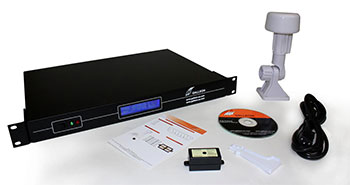
To utilise GPS as a source of time, all that is required is a GPS time server. Using an antenna, the time server receives the GPS signal, while NTP (Network Time Protocol) distributes it around the network.

GPS time server

With a GPS time server, a computer network is able to maintain accuracy to within a few milliseconds of the atomic clock time signal, which is translated into UTC time (Coordinated Universal Time) thanks to NTP, ensuring the network is running the same accurate time as other networks also synchronised to a UTC time source.

The Accuracy of the Speaking Clock

Wednesday, December 15th, 2010

The UK speaking clock has been around for nearly eighty years. It was started in 1936 when time keeping started to become more important to people’s lives. Initially available only in the London it was rolled out to the whole country during World War II.

There have been four people that have had honour of providing the permanent voice to the speaking clock over the last 70. And over 70 million calls are made to the speaking clock making it an important from of accurate time but have you ever wondered how accurate it is and where the time comes from and how accurate it is?

The speaking clock is controlled by a major British telecoms company who took over the General Post Office (GPO) and the time was originally supplied by the National Physical Laboratory (NPL) who also provide the MSF signal that NTP time servers use as a source of atomic clock synchronisation.

NPL no longer help with the speaking clock but the time is still controlled by NTP servers, either GPS or MSF, which ensures that the time you hear on the end of the telephone is accurate.

NTP servers are also commonly used by computer networks to ensure that IT systems, from traffic light signals to the office PC are all running an accurate form of time.

NTP time servers can either receive the MSF radio signal broadcast by NPL or, more commonly now, GPS signals beamed directly from space.

Often network administrators opt to use online NTP servers that send time signals over the internet but these are not as accurate and cause security problems so it is far better to have a dedicated NTP time server to control the time if you wish to have a computer network that is running accurately.

Finding an Online NTP Time Source

Wednesday, December 8th, 2010

Finding a source of time to synchronise a computer network to can be a challenge as there are a myriad of online time sources, all pertaining to be accurate and reliable; however, the truth can be rather different with many online sources either in too much demand, too far away or inaccurate.

NTP (Network Time Protocol) requires a source of UTC time (Coordinated Universal Time) which is kept true by atomic clocks. Online time sources are not themselves atomic clocks but NTP server devices that receive the time from an atomic clock which is then relayed to the devices that connect to the online time server.

There are two types of online time server: stratum 1 devices – devices that receive the time directly from an atomic clock, either using GPS or a radio reference signal. Stratum 2 devices  on the other hand are one step further away in that they are receive their time from a stratum 1 time server.

Because of demand, finding an online stratum 1 time server is next to impossible, and those that do take request usually do so under a subscription, which leaves the only choice for most people being a stratum 2 device.

There are plenty of resources on the internet that provide locations for online time servers such as http://support.microsoft.com/kb/262680

But there are drawbacks to using such devices; firstly, online stratum 2 time sources can’t be guaranteed and several surveys taken have found that the reliability and accuracy of many of them can’t be taken for granted.  Secondly, online sources of time require an open firewall port which can be manipulated by malicious bots or users – leading to security risks.

A far better solution for most networks is to install your own stratum 1 NTP server. These time server devices sync to atomic clocks outside the firewall (using GPS or radio signals) and therefore are not security risks. They are also accurate to a few milliseconds ensuring the network will always be accurate to UTC.

Using Atomic Clock Time Signals

Wednesday, November 10th, 2010

Accuracy is becoming more and more relevant as technology becomes increasingly important to the functioning of our everyday lives. And as our economies become more reliant on the global marketplace, accuracy and synchronisation of time is very important.

Computers seem to control much our daily lives and time is essential for the modern computer network infrastructure. Timestamps ensure actions are carried out by computers and are the only point of reference IT systems have for error checking, debugging and logging. A problem with the time on a computer network and it could lead to data getting lost, transactions failing and security issues.

Synchronisation on a network and synchronisation with another network that you communicate with are essential to prevent the above mentioned errors. But when it comes to communicating with networks across the globe things can be even trickier as the time on the other-side of the world is obviously different as you pass each time-zone.

To counter this, a global timescale based on atomic clock time was devised. UTC – Coordinated Universal Time – does away with time-zones enabling all networks across the globe to use the same time source – ensuring that computers, no matter where they are in the world, are synchronised together.

To synchronise a computer network, UTC is distributed using the time synchronisation software NTP (Network Time Protocol). The only complication is receiving a source of UTC time as it is generated by atomic clocks which are multi-million dollar systems that are not available for mass use.

Fortunately, signals from atomic clocks can be received using a NTP time server. These devices can receive radio transmissions that are broadcast from physic laboratories which can be used as a source of time to synchronise an entire network of computers to.

Other NTP time servers use the signals beamed from GPS satellites as a source of time. The positioning information in these signals is actually a time signal generated by atomic clocks onboard the satellites (which is then triangulated by the GPS receivers).

Whether it’s a radio referenced NTP server or a GPS time server – an entire network of hundreds, and even thousands of machines can be synchronised together.

The Effects of No Time Signal

Wednesday, November 3rd, 2010

NTP servers (Network Time Protocol) are an essential tool in the modern computer network. They control the time, ensuring every device on the network is synchronised.

Because of the importance of time in controlling nearly every aspect of computer networking accurate and synchronised time is essential which is why so many system administrators deploy a NTP time server.

These time servers use a single time source as a base to set all the clocks on a network to; the time is often got from the GPS network or radio signals broadcast from physics laboratories such as NPL in the UK (whose signal is broadcast from Cumbria).

Once this signal is received by the time server, the time protocol NTP then distributes it around the network – comparing the system clock of every device to the time reference and adjusting each device. By regularly assessing the drift of these devices and correcting for them NTP keeps clocks accurate to within milliseconds of the time signal and when this signal emanates from an atomic clock – it ensures the network is as accurate as physically possible, but what happens if you lose the time signal?

Damaged GPS antennas, maintenance of time signal transmitters or technical faults can lead to a NTP time sever failing to receive a time signal. Often, this is only temporary and normal service is resumed within a few hours but what happens if it doesn’t, and what is the effect of having a failed time signal?

Fortunately, NTP has back-up systems for just such an eventuality. If a time signal fails and there is no other source of time, NTP cleverly uses the average time from all the clocks on its network. So if some clocks have drifted a few milliseconds faster, and others a few milliseconds slower – then NTP takes the average of this drift ensuring that the time remains accurate for as long as possible.

Even if a signal has failed for several days – or even weeks – without knowledge of the system users, this does not mean the network will drift apart. NTP will still keep the entire network synchronised together, using the average drift, and while the longer the time signal remains off the les accurate the network will be it can still provide millisecond accuracy even after a few days of no time reference.

Time Synchronisation Getting it Right

Wednesday, October 20th, 2010

Time is essential for computers, networks and technology. It is the only reference technology has to ascertain if a task has happened or is due to take place. As time, in the from of timestamps, is so important for technology, when there is uncertainty over time, due to different devices on a network having different times, it can cause untold errors.

The problem with time in computing is that all devices, from routers to desktop PCs, have their own onboard timepiece that governs the system clocks. These system clocks are just normal electronic oscillators, they type commonly found in battery powered watches, and while these are adequate for humans to tell the time, the drifting of these clocks can see devices on a network, seconds and even minutes out of sync.

There are two rules for time synchronisation:

  • All devices on a network should be synchronised together
  • The network should be synchronised to UTC (Coordinated Universal Time)


NTP

To synchronise a network you need to make use of Network Time Protocol (NTP). NTP is designed for accurate network time synchronisation.  IT works by using a single source of time which it then distributes it to all devices on the NTP network.

NTP continually checks the devices for any drift and then adjusts to ensure the entire network is within a few milliseconds of the reference time.

UTC

Coordinated Universal Time is a global timescale that is kept true by atomic clocks. By synchronising a network to UTC you are in effect ensuring your network is synchronised to every other UTC network on the planet.

Using UTC as a reference source is a simple affair too. NTP time servers are the best way to find a secure source of UTC time. They use either GPS (Global Positioning System) as a source of this atomic clock time or specialist radio signals keeping the UTC time source external to the network for security reasons.

A single NTP server can synchronise a network of hundreds and even thousands of devices ensuring the entire network is to within a few milliseconds of UTC.

Using Atomic Clocks for Time Synchronisation

Wednesday, October 6th, 2010

The atomic clock is unrivalled in its chronological accuracy. No other method of maintaining time comes close to the precision of an atomic clock. These ultra-precise devices can keep time for thousands of years without losing a second in drift – in comparison to electronic clocks, perhaps the next most accurate devices, which can drift up to a second a day.

Atomic clocks are not practical devices to have around though. They use advanced technologies such as super-coolant liquids, lasers and vacuums – they also require a team of skilled technicians to keep the clocks running.

Atomic clocks are deployed in some technologies. The Global Positioning System (GPS) relies on atomic clocks that operate onboard the unmanned orbiting satellites. These are crucial for working out accurate distances. Because of the speed of light that the signals travel, a one second inaccuracy in any GPS atomic clock would lead to positing information being out by thousands of kilometres – but the actual accuracy of GPS is within a few metres.

While these wholly accurate and precise instruments for measuring time are unparalleled and the expensive of running such devices is unobtainable to most people, synchronising your technology to an atomic clock, in actual fact, is relatively simple.

The atomic clocks onboard the GPS satellites are easily utilised to synchronise many technologies to. The signals that are used to provide positioning information can also be used as a source of atomic clock time.

The simplest way to receive these signals is to use a GPS NTP server (Network Time Protocol). These NTP servers use the atomic clock time signal from the GPS satellites as a reference time, the protocol NTP is then used to distribute this time around a network, checking each device with the GPS time and adjusting to ensure accuracy.

Entire computer networks can be synchronised to the GPS atomic clock time by using just one NTP GPS server, ensuring that all devices are within milliseconds of the same time.